
Held on the Eve of the Historic Day of 13 Aban:
A Postcolonial Reading of 13 Aban at the University of Kurdistan / When Independence Transformed from Slogan into Action
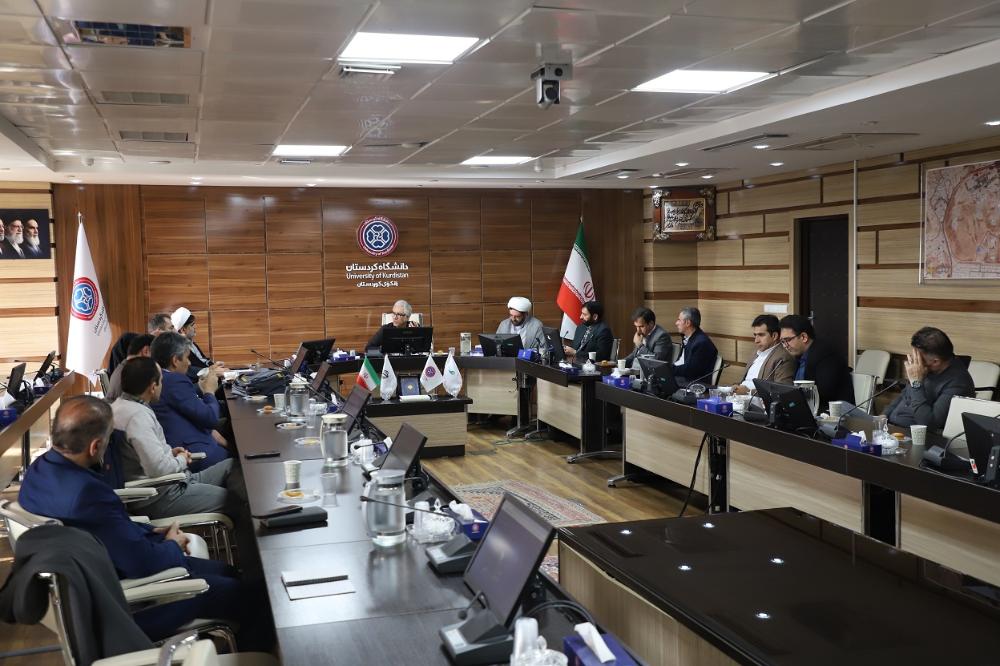



Coinciding with the arrival of 13 Aban (November 4), the National Day of Fighting Global Arrogance and the anniversary of the takeover of the US Den of Espionage, an academic seminar titled "A Postcolonial Reading of 13 Aban" was held with the aim of examining the sociological dimensions of this historical event and elucidating the relationship between colonialism, imperialism, and independence.
According to the Public Relations Office of the University of Kurdistan, this seminar took place on Tuesday, 12 Aban 1405 (November 3, 2026), featuring a lecture by Dr. Foad Habibi, a faculty member at the University of Kurdistan, in the university's conference hall. Drawing upon the perspectives of thinkers such as Edward Said and Frantz Fanon, the session analyzed colonial relations, the reproduction of domination, and the concept of reclaiming agency, while examining 13 Aban from the perspective of a transition from formal independence to real and practical independence.
13 Aban Was the Turning Point from Formal to Real Independence
By elucidating the link between colonialism and imperialism, Foad Habibi analyzed 13 Aban through the lens of transitioning from formal and legal independence to substantive independence and the reclamation of agency.
Pointing to the necessity of a theoretical rereading of the concept of colonialism, Habibi stated: "Colonialism should not be understood merely as territorial occupation, political domination, and the extraction of economic resources; rather, it must be examined in conjunction with the concept of imperialism as a global logic and mechanism."
Stating that colonialism is an act and imperialism is the underlying logic of that act, he added: "Colonialism has a historical concept, yet at the same time, we are confronted with a phenomenon that possesses durability and continuity, reproducing itself. One can speak of it as a form of 'eternal colonialism'—a force that, much like eternal fascism, can manifest and reproduce itself in different situations and across various forms and frameworks, while its underlying logic remains constant."
Referring to the emergence of neocolonialism following the end of the classical colonial era, this faculty member of the University of Kurdistan noted: "Many countries achieved official and legal independence after World War II, but this independence did not necessarily signify the end of colonial relations. In neocolonialism, countries are ostensibly independent, yet they remain situated within unequal global relations through economic and political mechanisms."
Emphasizing that colonialism should not be analyzed merely in terms of a moral dichotomy between good and bad states, Habibi clarified: "When we speak of a global logic known as imperialist logic, we are dealing with an unequal relationship between the center and the periphery. In this relationship, the center occupies the dominant position and the periphery the subordinate one, and it matters little which government or party is in power; the logic and the relationship continue to function."
Furthermore, referencing Edward Said’s theory of Orientalism, he identified the production of a system of knowledge and epistemology regarding Eastern societies as one of the primary mechanisms for reproducing colonialism, stating: "Within this system, the East is represented as an irrational, traditional, backward, and static entity, whereas the West is positioned as a modern, rational, and progressive society."
He added: "In Orientalism, history is stripped from Eastern societies, and backwardness is attributed to them as an inherent characteristic; whereas this very representation is part of the mechanism of power and paves the way for intervention and the reproduction of colonial relations."
Pointing to the views of Frantz Fanon regarding the impact of colonialism on the mind and psyche of colonized societies, the university professor remarked: "The issue of colonialism is not merely territorial occupation and resource extraction; rather, colonialism impacts the body, psyche, desires, and even the self-understanding of human beings. One of its consequences is the formation of a sense of inferiority and self-deprecation among colonized societies—a condition that can persist even after official independence."
Stating that understanding the event of 13 Aban requires attention to the issue of reclaiming agency, Habibi asserted: "On 13 Aban, we are confronted with a constituent power; that is, a force from below—the Muslim Student Followers of the Imam's Line—who intervene in this situation."
He continued: "What had occurred formally and legally, resulting in independence, acts in alignment with what a thinker like Fanon calls the reclamation of agency; meaning that you once again intervene in the situation as a subject—not merely in a formal, legal, and juridical manner, but as a subject who actively takes action."
Highlighting the significance of this event from the perspective of postcolonial theories, the faculty member of the University of Kurdistan added: "13 Aban can be understood as an effort to exit the position of the 'Other' and become a center for the production of knowledge and narrative; an endeavor for the subaltern to be able to speak and step out of the position of being an object represented by others."
In concluding his remarks, Habibi emphasized: "The most important point that occurs in Aban in this regard is that, for almost the first time, formal and nominal independence moves toward real, practical, and objective independence, and this is the moment that renders 13 Aban significant for rethinking and renewed reflection."

Faculty Systems

Student Systems

Staff Systems

Virtual Tour

Telephone Directory

Privacy Policy Statement
Quick Links
Electronic Services
Useful Links


University of Kurdistan, Pasdaran Boulevard, Sanandaj, Iran

Postal Code: 6617715175

Phone: +988733664600-8

Email: info@uok.ac.ir


site visit
- today:
- yesterday:
- all:
Last Update
25 Nov 2026 - 07:05:34