
Deputy Minister for Research at the Ministry of Science, Research, and Technology:
The University of Kurdistan Is a Flourishing and Progressive Academic Institution Nationwide
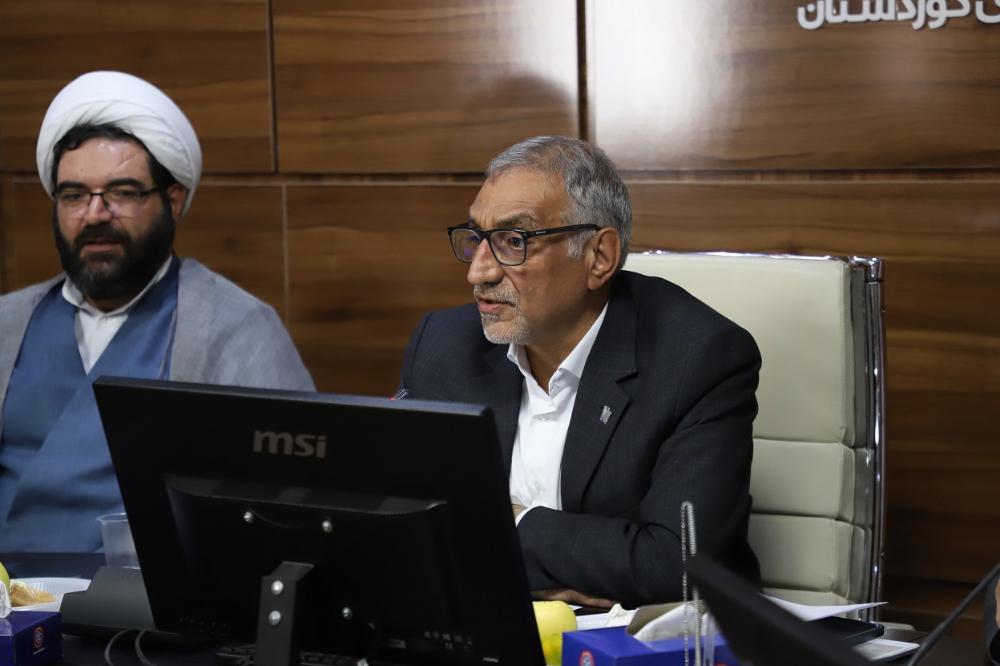



Affirming that the University of Kurdistan has sustained an upward trajectory in recent years contrary to the downward research trends across higher education institutions in the country, the Deputy Minister for Research at the Ministry of Science, Research, and Technology stated: "The University of Kurdistan is a flourishing and progressive academic institution nationwide, and this constructive trajectory must be sustained."
According to the Public Relations Office of the University of Kurdistan, Dr. Seyed Mehdi Abtahi, during his official visit to Kurdistan Province on Sunday, October 11, 2026 (19 Mehr 1405), and while addressing the University Council meeting attended by the University Chancellor, vice-chancellors, and faculty members in the university conference hall, addressed the 2.7 percent decline in the country's scientific publications since 2020 and 2021, identifying the shortage of financial resources tailored to research requirements and deficient institutional support as key contributing factors.
Noting that no qualitative degradation has yet been observed in the nation's scientific publications, he added: "Despite the contraction in the overall volume of articles, we have successfully preserved the qualitative standard of our scientific contributions to an acceptable degree."
Abtahi highlighted the research performance of the University of Kurdistan, stating: "During 2020 and 2021, concurrently with the broader downward research trend observed in universities across the country, this institution followed an upward path of progress; a fact demonstrating that the University of Kurdistan has pursued its advancement independently of the general research trends in the country."
Reiterating that the country does not suffer from a shortage of researchers, the Deputy Minister clarified: "The fundamental issue is not an absence of scholars, but rather a lack of financial resources aligned with research needs and inadequate support for investigative activities, both of which have impacted the trajectory of national scientific publication."
Addressing the migration of researchers, he noted: "Statistical data indicates that between 2005 and 2006, Iran lost approximately 20,000 researchers, 20 percent of whom were university professors."
Emphasizing the vital need to reinforce the academic foundations of universities, Abtahi stated: "Academic institutions must actively support faculty members and academic elites. Support for researchers and the allocation of research grants must remain anchored within academic avenues and the established framework of university structures."
He further added: "If faculty members depart from academic bodies, these institutional frameworks will inevitably weaken; consequently, we must prioritize the consolidation of our academic structures more vigorously than ever before."
Underscoring the critical importance of advancing scientific capabilities and international science diplomacy, the Deputy Minister for Research concluded: "Depletion of manpower and the brain drain of elites and researchers result in the loss of research infrastructure and human capital, while passivity in science diplomacy amounts to relinquishing strategic opportunities; thus, we must adopt a proactive approach in this domain."

Faculty Systems

Student Systems

Staff Systems

Virtual Tour

Telephone Directory

Privacy Policy Statement
Quick Links
Electronic Services
Useful Links


University of Kurdistan, Pasdaran Boulevard, Sanandaj, Iran

Postal Code: 6617715175

Phone: +988733664600-8

Email: info@uok.ac.ir


site visit
- today:
- yesterday:
- all:
Last Update
25 Nov 2026 - 07:05:34